How Do Customer Card Trades Work in TCG Card Shop Simulator?
Customer trade spawn odds up to 20%, buy-offer scoring, card swaps, and pack-unlocked Ghost and graded pools.
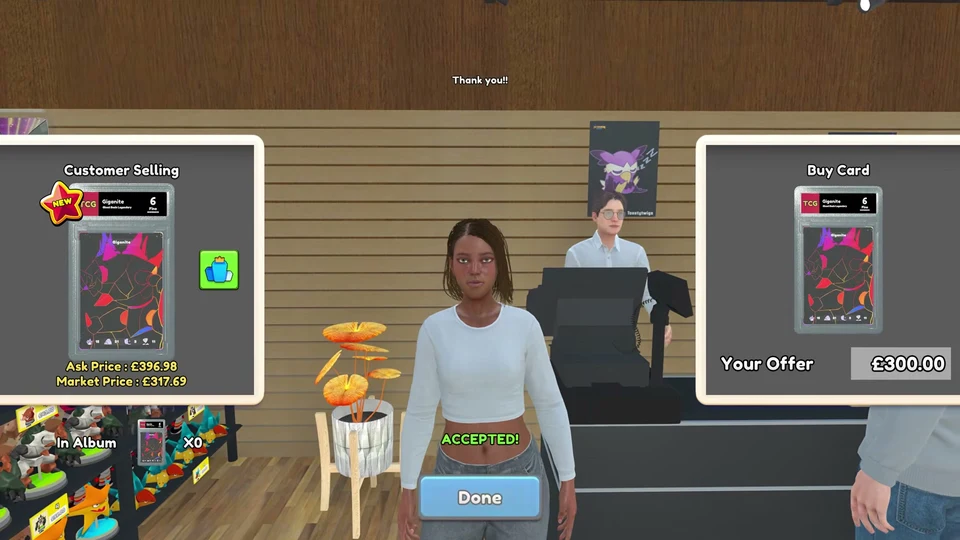
Customers visit beside a trade-enabled 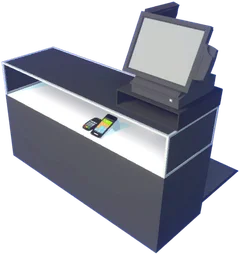 Checkout Counter up to a 20% trade chance per shopper (once per customer, starting at 3% plus your internal shop level divided by 4, capped at 5% in morning, 10% in afternoon, 15% in evening, and 8% at night before adding shop level divided by 20). Each trade rolls for a card swap at a percentage chance equal to your internal shop level capped at 40%, and otherwise asks you to buy a card priced at 0.7x to 1.2x market value plus any high-value bonus. Your buy offer succeeds whenever it stays at or within $0.01 of the customer’s ask price, while lower offers are scored against market value across 0 to 4 possible decline rounds.
Because card market prices roll per save and drift daily, ask and offer figures vary across saves and days; see the card prices guide for full pricing mechanics.
Trade Spawn Odds and Swap vs. Sell Rolls
A customer standing beside the Checkout Counter displays a red exclamation mark when ready to sell or trade a card.
- Trade spawn chance: The base rate adds 3 to your internal shop level divided by 4, clamps that sum against the time-of-day cap (5 in morning, 10 in afternoon, 15 in evening, and 8 at night), adds your internal shop level divided by 20, and caps the final percentage at 20%.
In a swap, the game looks for a card priced between 0.75x and 1.5x the customer’s card (falling back to a random pick in the 0.35x to 2x band if needed), and the customer accepts whenever you own the requested card. A card-grading patch also let customers sell or trade graded cards and gave them a chance to request cards from your album.
| Pack Unlock | License Lv | +Destiny | +Ascension | +Ghost / 250 | +Ghost Foil | +Graded |
|---|---|---|---|---|---|---|
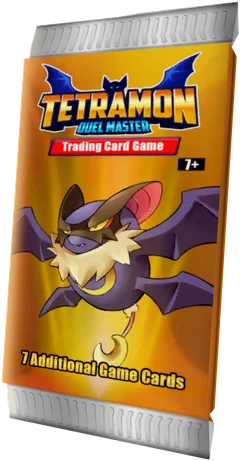 Rare Card Pack | Lv 5 | — | — | +1 | — | +2% |
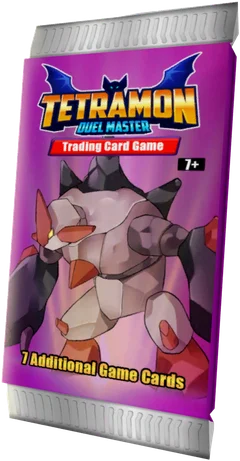 Epic Card Pack | Lv 12 | — | — | +1 | — | +2% |
 Legendary Card Pack | Lv 20 | — | — | +2 | +1% | +2% |
 Basic Destiny Pack | Lv 25 | +15% | — | +1 | +1% | +2% |
 Rare Destiny Pack | Lv 30 | +10% | — | +1 | +1% | +2% |
 Epic Destiny Pack | Lv 40 | +10% | — | +1 | +1% | +2% |
 Legendary Destiny Pack | Lv 50 | +15% | — | +2 | +1% | +3% |
 Ascension Card Pack | Lv 70 | — | +50% | +2 | +1% | +3% |
Ask Prices, Offer Scoring, and Counter-Offers
When a customer sells a card to your shop, their initial ask price multiplies today’s market price by a factor rolled from 0.6 to 1.3 and clamped between 0.7 and 1.2.
If you offer at least the ask price minus $0.01 and hold enough cash, the customer accepts right away. Lower offers are evaluated by a score that starts at 100 adjusted for how far your offer sits below the ask price, then shifts by 5 to 15 points up if your offer beats market value or down if it falls below market value:
- Deep-discount penalties: Offers more than 10% below the ask price subtract bracket penalties scaling from 5 to 15 points down to 45 to 75 points when more than 50% below ask.
- Repeat-decline penalties: Each rejection subtracts 5 to 15 points per prior decline, and repeating the same or a lower offer subtracts another 10 to 25 points per prior decline.
Compare these trade margins against standard shelf markups in the best price to set guide before listing purchased singles on a  Card Table.
Unlocked Card Pools, Ghost Cards, and Graded Slabs
At the start of a save, customers pull trade offers from Tetramon with a 1-in-250 chance for a Ghost card and 0% odds for Destiny, Ascension, Ghost foils, or graded cards. As your zero-based shop level reaches each booster pack license threshold (one displayed shop level after the license unlocks), each unlocked pack expands the trade pool:
- Tetramon tiers: Unlocking the Rare Card Pack (license level 5) adds 1 Ghost roll per 250 and 2% graded chance, Epic Card Pack (level 12) adds 1 Ghost roll per 250 and 2% graded chance, and Legendary Card Pack (level 20) adds 2 Ghost rolls per 250, 1% Ghost foil chance, and 2% graded chance.
- Destiny tiers: Unlocking the Basic Destiny Pack (level 25) adds 15% Destiny odds, Rare Destiny Pack (level 30) and Epic Destiny Pack (level 40) each add 10% Destiny odds, and Legendary Destiny Pack (level 50) adds 15% Destiny odds plus 2 Ghost rolls per 250 and 3% graded chance (all four also raise Ghost foil by 1%, and the first three add 1 Ghost roll per 250 and 2% graded chance).
- Ascension tier: Unlocking the Ascension Card Pack (level 70) adds 50% Ascension odds, 2 Ghost rolls per 250, 1% Ghost foil chance, and 3% graded chance.
Check the most valuable cards guide to see which Ghost and Ascension variants carry the highest market ranges.
| Grade | Chance (Ungraded) | Multiplier Range | Flat Bonus / Mult |
|---|---|---|---|
| Grade 1 | 0.30% | 0.01x – 0.15x | — |
| Grade 2 | 0.30% | 0.15x – 0.25x | — |
| Grade 3 | 0.60% | 0.25x – 0.35x | — |
| Grade 4 | 1.20% | 0.35x – 0.45x | — |
| Grade 5 | 5.92% | 0.45x – 0.65x | — |
| Grade 6 | 4.32% | 0.65x – 1x | — |
| Grade 7 | 8.64% | 1x – 1.25x | +$2 |
| Grade 8 | 17.28% | 1.25x – 1.5x | +$4 |
| Grade 9 | 23.04% | 1.5x – 3x | +$8 |
| Grade 10 | 38.40% | 3x – 7x | +$12 |
When a trade triggers the graded percentage roll, the offered card receives a random grade from Grade 1 to Grade 10, scaling its market price by the corresponding grade multiplier band and flat bonus. Grades 1 through 6 carry no flat bonus and top out at 1.0x market value, while Grades 7 through 10 add multipliers up to 7.0x plus up to $12 per multiplier (3.0 to 7.0 times $12 at Grade 10), so check our card grading ROI guide before buying or trading slabs.