Card Prices Guide: Market Rolls, Drift, Buy Chance & Grading
How card market values roll per save, drift daily, interact with customer markup tiers and budgets, and scale across Grade 1 to Grade 10 slabs.
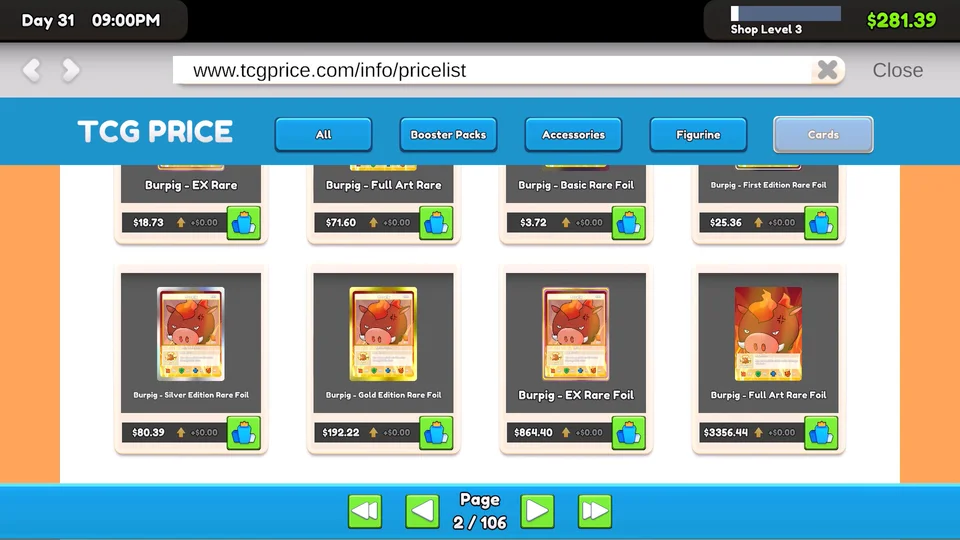
Card market prices in TCG Card Shop Simulator roll independently for each save file and drift daily rather than sitting at fixed values. Across 403 collectible cards spanning four sets in our extracted build, a card’s sale price comes from its base variant band, daily market movement, your shelf price, and any Grade 1 to Grade 10 slab modifier, while a shopper’s carried budget only caps whether they can afford the purchase. A later Halloween update added six new Ghost cards for a total of 24 rare cards in that patch note, bringing new Ghost variants into later builds beyond those 403 extracted cards.
Use the card price calculator to compare your shelf price against today’s market value.
How Base Card Prices Roll Per Save
When you start a new shop save, the game rolls a starting market value for every card variant inside a band determined by set, rarity, border tier, and foil finish. In Tetramon (121 cards) and Destiny (121 cards), each card exists in 12 variants covering six borders—Basic, First Edition, Silver Edition, Gold Edition, EX, and Full Art—in both non-foil and foil prints.
Higher rarities and foil finishes raise the base band, while Ascension (121 cards) and Ghost (40 card rows across 20 monsters in black and white halves) use their own set scaling:
- Common cards in Tetramon: A Basic non-foil
 Pigni rolls between $0.02 and $0.24, while a Full Art foil Common rolls between $975.00 and $2100.00.
- Legendary cards in Tetramon: A Full Art foil Legendary card in Tetramon rolls a base range from $2590.20 to $5703.30.
- Destiny scaling: Destiny cards follow the same 12-variant layout with higher ceilings, reaching $3107.70 to $8553.30 on Full Art foil prints of Legendary cards.
- Ascension flat bands:
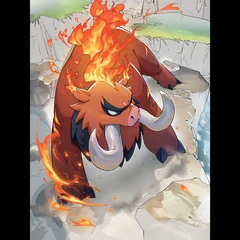 Blazoar (Ascension) and every other Ascension card share the same per-border price bands across all four rarities, topping out at $2218.12 to $20160.00 on Borderless Full Art foil.
- Ghost cards: All 40 extracted Ghost card rows (20 black and 20 white halves) are Legendary cards printed only in Full Art, rolling from $233.70 to $611.30 in non-foil and from $7247.70 to $18243.30 in foil (before the Halloween update’s six extra Ghost cards).
| Border Variant | Foil | Base Price Range |
|---|---|---|
| Basic | Non-Foil | $0.02 – $0.24 |
| Basic | Foil | $1.00 – $6.00 |
| First Edition | Non-Foil | $0.20 – $1.20 |
| First Edition | Foil | $3.00 – $12.00 |
| Silver Edition | Non-Foil | $0.75 – $3.00 |
| Silver Edition | Foil | $12.00 – $36.00 |
| Gold Edition | Non-Foil | $2.00 – $6.00 |
| Gold Edition | Foil | $50.00 – $120.00 |
| EX | Non-Foil | $7.50 – $19.50 |
| EX | Foil | $300.00 – $650.00 |
| Full Art | Non-Foil | $30.00 – $70.00 |
| Full Art | Foil | $975.00 – $2100.00 |
The table below summarizes the rolled base ranges and full drift ranges across all six border tiers for Common cards in Tetramon.
| Border tier | Non-foil base | Foil base | Foil drift span |
|---|---|---|---|
| Basic | $0.02 to $0.24 | $1.00 to $6.00 | $0.20 to $18.00 |
| First Edition | $0.20 to $1.20 | $3.00 to $12.00 | $0.60 to $36.00 |
| Silver Edition | $0.75 to $3.00 | $12.00 to $36.00 | $2.40 to $108.00 |
| Gold Edition | $2.00 to $6.00 | $50.00 to $120.00 | $10.00 to $360.00 |
| EX | $7.50 to $19.50 | $300.00 to $650.00 | $60.00 to $1,950.00 |
| Full Art | $30.00 to $70.00 | $975.00 to $2,100.00 | $195.00 to $6,300.00 |


See the most valuable cards guide for full set rankings and pull sources.
Daily Price Drift Bounds and Market Crashes
After initial save generation, market values update each in-game day across a tracked 30-day price history. Each card receives at most two market-price update calls per day—one positive-type roll and one negative-type roll—where a matching call shifts the value by up to 5 percent, and every card on every call also has a 40 percent chance to add or subtract the base step divided by 2.5 (up to 2 percentage points extra).
Before the crash rule triggers, those combined calls cap normal daily movement at 14 percent in either direction. Over consecutive days, cumulative drift stretches every variant from its minimum drift floor to its maximum drift ceiling:
- Basic non-foil Common: A Basic non-foil Common in Tetramon can drift as low as $0.00 and as high as $0.72.
- Rare foil range: A
 Burpig (Rare) in Full Art foil rolls between $1125.30 and $2813.40 at base, then drifts between $225.06 and $8440.20.
- Ascension foil peak: Borderless Full Art foil Ascension cards span $443.62 to $60480.00 across full market drift.
- Ghost foil peak: Full Art foil cards in Ghost span $1449.54 to $54729.90 from drift floor to drift ceiling.
Workers assigned to Set Price walk through your item shelves and for-sale card tables to update price tags once per day, skipping display-only card shelves that have no price tags.
Read the daily card price changes guide to see how market shifts affect holding vs selling.
Customer Markup Tiers and Buy Chance
When you place singles on a 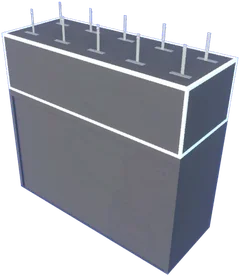 Card Table (including
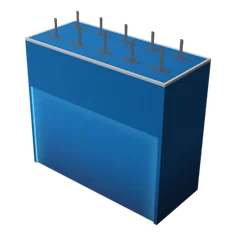 Card Table Blue,
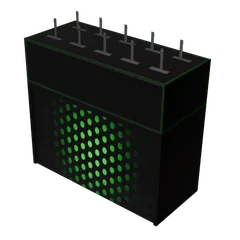 Card Table Green, and the
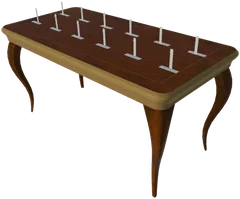 Vintage Card Table), shoppers compare your tag against today’s market value, whereas
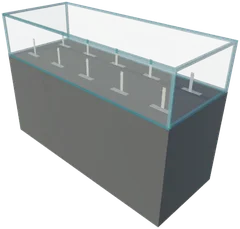 Card Display Table,
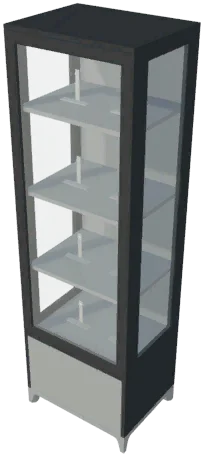 Small Card Display,
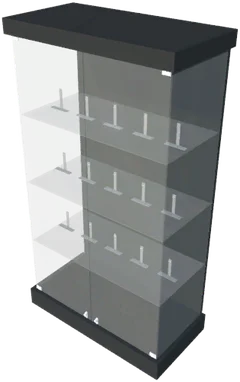 Big Card Display, and
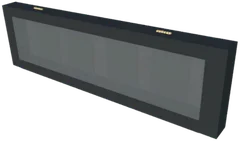 Wall Display Case hold cards for display only and cannot sell singles. Customer buy probability steps down across 10 markup tiers from 100 percent down to 0 percent:
- Deep discount (-20% or lower): Pricing at or below a 0.805x market ratio gives a 100 percent base buy chance.
- Small discount (-10% to 0%): Pricing up to a 1.005x market ratio keeps base buy chance at 90 percent.
- Mild markup (0% to +20%): Pricing in Tier 4 (0% to +10%, up to 1.105x) holds a 75 percent base chance, while pushing into Tier 5 (+10% to +20%, up to 1.205x) drops the tier base to 60 percent.
- Higher markup (+20% to +40%): Going into Tier 6 (+20% to +30%, up to 1.305x) drops the tier base to 45 percent, and Tier 7 (+30% to +40%, up to 1.405x) drops it to 15 percent.
- Hard ceiling (above +60%): The +50% and +60% tiers drop to 5 percent and 1 percent (1.605x upper bound), and anything past +60% hits 0 percent.
| Markup vs Market | Base Buy Chance | Ratio Upper Bound |
|---|---|---|
| <= -20% | 100% | 0.805x |
| -20% to -10% | 95% | 0.905x |
| -10% to 0% | 90% | 1.005x |
| 0% to +10% | 75% | 1.105x |
| +10% to +20% | 60% | 1.205x |
| +20% to +30% | 45% | 1.305x |
| +30% to +40% | 15% | 1.405x |
| +40% to +50% | 5% | 1.505x |
| +50% to +60% | 1% | 1.605x |
| > +60% | 0% | — |
Check the best price to set guide for practical markup targets across cheap and high-ticket singles.
Customer Carry Budgets by Shop Level
A favorable markup tier cannot complete a sale if the shopper does not carry enough cash to cover your sticker price. Customer maximum carry money scales with your displayed shop level and unlocked rooms:
- Shop level 1 (0 rooms): The base carry budget starts at $100 (individual rolls scale up to 4x base, plus a 0.2% rich-customer bonus roll of $50,000 to $1,000,000), leaving 3.43% of shoppers able to spend $100 or more.
- Shop level 10 (3 rooms): Max carry rises to $1,750, with 44.97% able to spend at least $1,000 and 0.3% able to spend $5,000 or more.
- Shop level 20 (8 rooms): Max carry reaches $4,000, giving 76.09% of shoppers at least $1,000 and 2.22% at least $5,000.
- Shop level 40 (15 rooms): Max carry reaches $7,750, bringing $5,000-plus shoppers up to 37.44%.
- Shop level 60 (30 rooms): Max carry hits $13,500, with 64.26% able to spend $5,000 or more.
- Shop level 80 (30 shop rooms and 14 warehouse rooms): Max carry climbs to $21,600, the rich bonus reaches 2%, and 77.94% can spend $5,000 or more.
- Shop level 115 (max progression): Max carry caps at $25,100, with 96.27% able to spend $1,000 or more and 81.02% able to spend $5,000 or more.
Customers also visit beside the 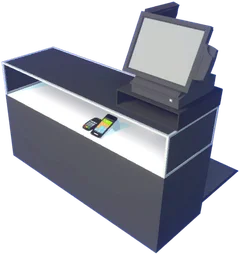 Checkout Counter to sell or trade cards, including graded slabs, rather than only buying off your tables. Read our customer trades guide for trade spawn odds, offer scoring, and card swaps.
| Shop Level | Rooms | Max Carry | Rich Roll | Can Spend 100+ | Can Spend 1,000+ |
|---|---|---|---|---|---|
| Lv 1 | 0 | $100 | 0.20% | 3.4% | 0.2% |
| Lv 10 | 3 | $1,750 | 0.22% | 95.5% | 45.0% |
| Lv 20 | 8 | $4,000 | 0.25% | 98.1% | 76.1% |
| Lv 40 | 15 | $7,750 | 0.32% | 99.0% | 87.7% |
| Lv 60 | 30 | $13,500 | 0.71% | 99.4% | 93.0% |
| Lv 80 | 30 | $21,600 | 2.00% | 99.7% | 95.7% |
| Lv 115 | 30 | $25,100 | 2.00% | 99.7% | 96.3% |
Read the customer carry budget guide before stocking multi-thousand-dollar foils early.
Card Grading Multipliers and Fees
You can mail up to 8 cards per package through The Cardinal’s Grading app on your phone and inspect graded market values by grade in the price graph screen. Four service tiers trade turnaround time for fee per card: Value costs $10 for 12 days, Standard costs $40 for 7 days, Express costs $200 for 4 days, and Premium costs $1,500 for 2 days.
An ungraded submission rolls across ten grades weighted toward the top end: Grade 10 lands 38.4% of the time, Grade 9 lands 23.04%, Grade 8 lands 17.28%, Grade 7 lands 8.64%, Grade 6 lands 4.32%, Grade 5 lands 5.92%, Grade 4 lands 1.2%, Grade 3 lands 0.6%, Grade 2 lands 0.3%, and Grade 1 lands 0.3%. Regrading an existing slab carries a 30% chance to move up one grade, a 41% chance to stay unchanged, and a 29% chance to drop one grade within the Grade 1 to Grade 10 cap.
| Grade | Chance (Ungraded) | Multiplier Range | Flat Bonus / Mult |
|---|---|---|---|
| Grade 1 | 0.30% | 0.01x – 0.15x | — |
| Grade 2 | 0.30% | 0.15x – 0.25x | — |
| Grade 3 | 0.60% | 0.25x – 0.35x | — |
| Grade 4 | 1.20% | 0.35x – 0.45x | — |
| Grade 5 | 5.92% | 0.45x – 0.65x | — |
| Grade 6 | 4.32% | 0.65x – 1x | — |
| Grade 7 | 8.64% | 1x – 1.25x | +$2 |
| Grade 8 | 17.28% | 1.25x – 1.5x | +$4 |
| Grade 9 | 23.04% | 1.5x – 3x | +$8 |
| Grade 10 | 38.40% | 3x – 7x | +$12 |
Grades 1 through 5 (0.01x–0.15x at Grade 1 up to 0.45x–0.65x at Grade 5) apply zero flat bonus and cut value below ungraded market price, while Grade 6 (0.65x–1.0x, zero flat bonus) tops out equal to ungraded market price. Starting at Grade 7, cards gain both higher multipliers and a flat bonus per multiplier: $2 at Grade 7 (1.0x–1.25x), $4 at Grade 8 (1.25x–1.5x), $8 at Grade 9 (1.5x–3.0x), and $12 at Grade 10 (3.0x–7.0x).
Because that Grade 10 flat bonus scales every card, even a Basic non-foil Pigni reaches $36.06 to $85.68 at Grade 10, while a Grade 10 Borderless Full Art foil Blazoar (Ascension) climbs to $6690.36 to $141204.00.
Use the card grading ROI guide and the grading calculator to check expected profit after service fees.