Why Customers Stop Buying Expensive Cards
Customer carry budgets scale with shop level, main rooms, and warehouse rooms, capping single-card sales even at fair prices.
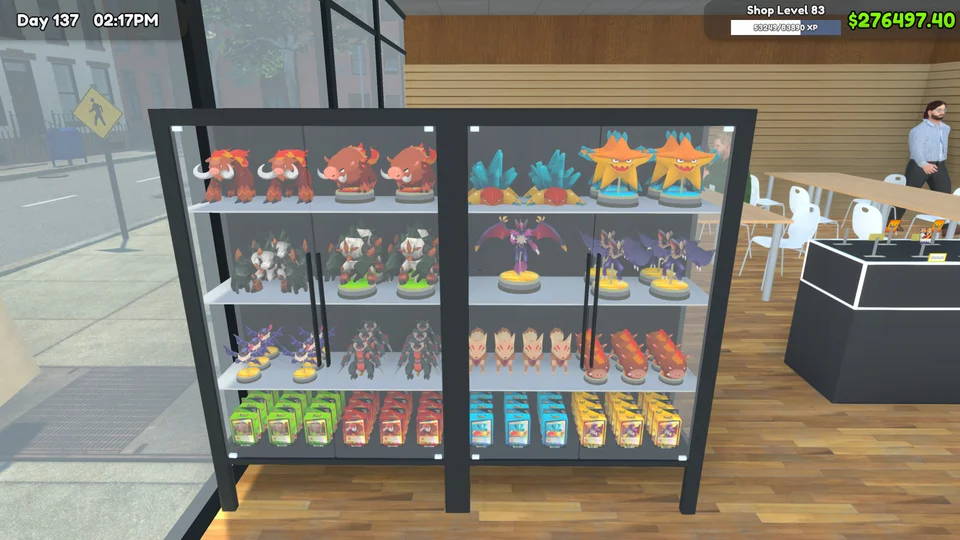
Customers stop buying expensive singles because every shopper spawns with a hidden wallet limit capped by your shop level, unlocked shop rooms, and warehouse rooms. Even when a card passes the markup roll, buyers say they do not have enough money if the card’s price pushes their basket over that limit. Card market prices are ranges rolled per save rather than fixed numbers, so pair the card prices guide with your store progression before stocking high-end singles.
How customer carry budgets scale
At shop level 1 with 0 extra rooms, a customer’s base maximum money sits at $100, with a 64.15 percent chance to carry at least $50 and only a 3.43 percent chance to carry at least $100. Adding rooms and levels raises that ceiling steadily across early, mid, and late progression:
- Level 1 (0 rooms) caps base max carry at $100, with a 0.2 percent rich-buyer bonus roll and a 0.2 percent chance to afford $1,000 or more.
- Level 10 (3 rooms) raises base max carry to $1,750, giving a 95.54 percent chance to afford $100 and a 44.97 percent chance to afford $1,000.
- Level 20 (8 rooms) pushes base max carry to $4,000, raising the $1,000 threshold to 76.09 percent while $5,000 cards stay at 2.22 percent.
- Level 40 (15 rooms) brings base max carry to $7,750, pushing $1,000 affordability to 87.7 percent and $5,000 affordability to 37.44 percent.
- Level 60 (30 main rooms) reaches $13,500 base max carry, with 92.97 percent able to afford $1,000 and 64.26 percent able to afford $5,000.
- Level 80 (30 main rooms plus 14 warehouse rooms) lifts base max carry to $21,600 and caps the rich-buyer roll at 2 percent, with 95.66 percent affording $1,000 and 77.94 percent affording $5,000.
- Level 115 (30 main rooms plus 14 warehouse rooms) reaches $25,100 base max carry, where 96.27 percent can spend $1,000 and 81.02 percent can spend $5,000.
| Shop Level | Rooms | Max Carry | Rich Roll | Can Spend 100+ | Can Spend 1,000+ |
|---|---|---|---|---|---|
| Lv 1 | 0 | $100 | 0.20% | 3.4% | 0.2% |
| Lv 10 | 3 | $1,750 | 0.22% | 95.5% | 45.0% |
| Lv 20 | 8 | $4,000 | 0.25% | 98.1% | 76.1% |
| Lv 40 | 15 | $7,750 | 0.32% | 99.0% | 87.7% |
| Lv 60 | 30 | $13,500 | 0.71% | 99.4% | 93.0% |
| Lv 80 | 30 | $21,600 | 2.00% | 99.7% | 95.7% |
| Lv 115 | 30 | $25,100 | 2.00% | 99.7% | 96.3% |
How Shop Lot B and expansions raise budgets
Expanding your floor space does more than fit extra tables because unlocked rooms feed straight into each customer’s wallet cap. Unlocking Shop Lot B requires shop level 15 and $5,000, and an early access patch fixed a bug so unlocking that expansion properly raises customer max money alongside main rooms.
Each main room adds $250 to a customer’s base carry cap, unlocking the warehouse adds $500, each warehouse room adds $400, and each shop level adds $100 up to the $30,000 base ceiling; check our shop expansion guide when planning space for high-multiplier slabs from our card grading guide.



Budget limits vs markup buy chance
Wallet caps work separately from the price-to-market markup check that decides whether a customer wants a card at your shelf price. Setting a card at 0 percent to minus 10 percent below market carries a 90 percent base buy chance, while marking it 10 percent to 20 percent above market drops the base chance to 60 percent, and marking it above 60 percent over market drops buy chance to 0 percent.
A single failed card check does not force an immediate exit: each failed card roll adds 1 to the shopper’s fail counter, and they only stop browsing once that count exceeds a random limit from 3 up to 7 plus your card shelf count (capped at 15), checking out if their bag is non-empty or exiting if it is empty. Use our best price to set guide to tune your margins without losing sales to sticker shock.
| Markup vs Market | Base Buy Chance | Ratio Upper Bound |
|---|---|---|
| <= -20% | 100% | 0.805x |
| -20% to -10% | 95% | 0.905x |
| -10% to 0% | 90% | 1.005x |
| 0% to +10% | 75% | 1.105x |
| +10% to +20% | 60% | 1.205x |
| +20% to +30% | 45% | 1.305x |
| +30% to +40% | 15% | 1.405x |
| +40% to +50% | 5% | 1.505x |
| +50% to +60% | 1% | 1.605x |
| > +60% | 0% | — |