Why Card Prices Change Every Day in TCG Card Shop Simulator
How daily market drift updates card values across 30 days of Price History, plus how tournaments apply direct price multipliers to card market values.
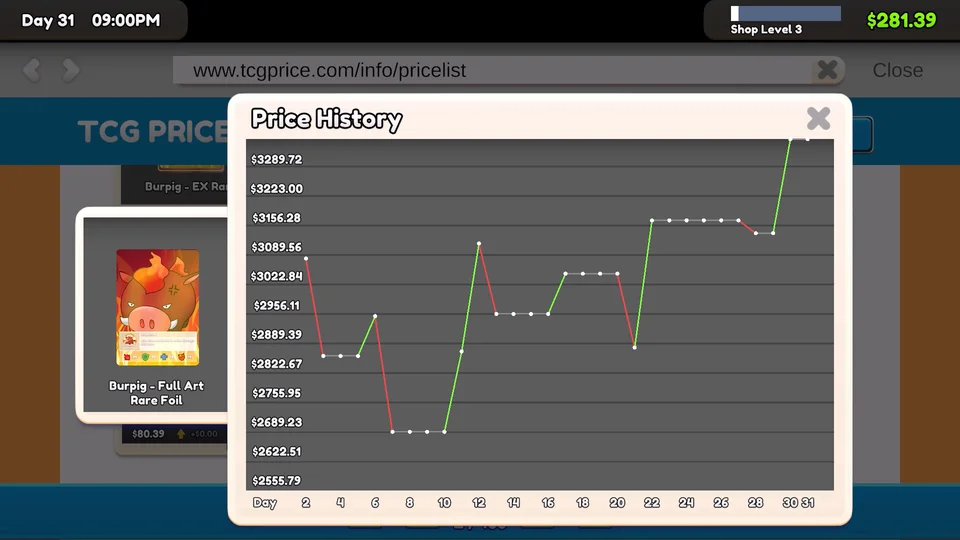
Card market prices change each morning because the game runs up to 2 daily market update calls per card—one positive and one negative—shifting matching cards up to 5 percent per call plus up to 2 percent random extra, while tracking 30 days of Price History. Each card starts from a base value rolled as a range per save, and daily swings add up across matching traits before any crash check applies. Read the card prices guide for how these daily shifts connect to base pricing and grading.
How Daily Drift Moves Market Prices
Every morning, the daily market roll can apply up to 2 price update calls to each card, capped at a combined 14 percent step before the crash rule runs. Every call also carries a 40% chance to add or subtract an extra swing equal to the base step divided by 2.5.
| Border Variant | Foil | Base Price Range |
|---|---|---|
| Basic | Non-Foil | $0.02 – $0.36 |
| Basic | Foil | $1.20 – $9.00 |
| First Edition | Non-Foil | $0.24 – $1.80 |
| First Edition | Foil | $3.60 – $18.00 |
| Silver Edition | Non-Foil | $0.90 – $4.50 |
| Silver Edition | Foil | $14.40 – $54.00 |
| Gold Edition | Non-Foil | $2.40 – $9.00 |
| Gold Edition | Foil | $60.00 – $180.00 |
| EX | Non-Foil | $9.00 – $29.25 |
| EX | Foil | $360.00 – $975.00 |
| Full Art | Non-Foil | $36.00 – $105.00 |
| Full Art | Foil | $1170.00 – $3150.00 |
Daily events target card groups such as all foil cards, non-foil cards, specific borders like Gold or full art, or individual elements like Fire and Earth. Because one daily roll pushes matching cards up and the other pushes matching cards down, matching both events at once opposes the two shifts rather than stacking in one direction.
In Destiny, a Rare foil card with a Full Art border starts between $1350.30 and $4219.65, yet full downward drift pushes its floor to $270.06 while full upward drift raises its ceiling to $12658.95. Check our pricing tiers guide whenever market drift shifts your cards away from your old sticker prices.
How Tournaments Nudge Card Prices
Hosting shop tournaments adds a controlled push to market values alongside the daily market roll.
| Format | Unlock Plays | Host Cost | Entry Fee | Price Impact |
|---|---|---|---|---|
| Standard | 0 | $0 | $7.00 | 0% to +5% |
| Pauper | 50 | $50 | $8.00 | -5% to 0% |
| Fire Cup | 100 | $70 | $10.00 | 0% to +10% |
| Earth Cup | 150 | $70 | $10.00 | 0% to +10% |
| Water Cup | 200 | $70 | $10.00 | 0% to +10% |
| Wind Cup | 250 | $70 | $10.00 | 0% to +10% |
- Standard: Unlocked from 0 plays with no host cost and a $7.00 base fee, shifting random rarities between 1.0 and 1.05.
- Pauper: Unlocked at 50 plays for a $50 host fee and $8.00 entry fee, pushing Common cards up and non-Common cards down within a 0.95 to 1.0 range.
- Elemental cups: The Fire Cup (100 plays), Earth Cup (150 plays), Water Cup (200 plays), and Wind Cup (250 plays) each cost $70 to host with a $10.00 entry fee, lifting their own element while pressing another down across a 1.0 to 1.1 band.
Read our tournaments guide for full unlock milestones, table requirements, and prize planning across all tournament formats.
Tracking Price History and Update Changes
The in-game price graph stores 30 days of market records so you can spot whether a card is climbing above its rolled baseline or recovering from a dip.



For example,  Burpig in the Tetramon set spans $0.09 to $2813.40 across its 12 variants, and its Rare foil Full Art variant swings from a $225.06 drift floor up to an $8440.20 drift ceiling.
Early prologue updates added a cap on item price changes and tweaked daily change amounts, and an early access patch fixed Destiny and Ghost cards failing to update in value. When card grading arrived, the price graph screen gained grade selection so you can check market prices for each individual grade. Compare these swings against our most valuable cards guide to time big single-card sales.